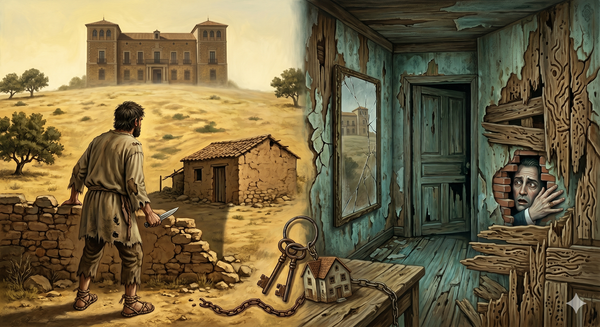
On Violaine Bérot's Comme des bêtes
What I found in this book, and was not quite expecting, is that the question of margin and norm is not posed abstractly. It is posed through the body.
What the Animals Know
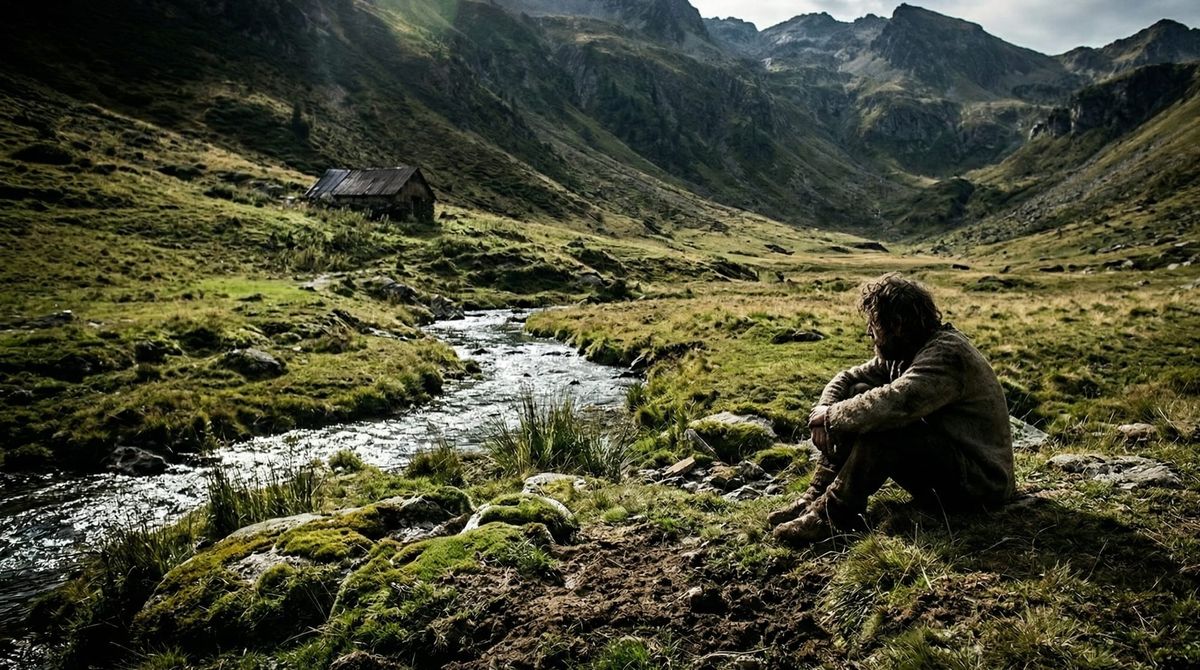
A ganadero climbs to his upland pastures one morning and, before descending to his herd, raises his binoculars. Among the cattle, he spots a shape he doesn't immediately recognise - not a calf, but a boy, or something shaped like a boy, enormous and slow-moving, standing beside his injured cow with one hand placed between her horns. The cow, notoriously difficult, notoriously suspicious of anyone who tries to examine her damaged pelvis, stands perfectly still. The man watches for a long time. He watches the boy's hands move to the animal's flanks, watches the rhythm that settles between them - rocking, he thinks, though he is not sure if it is the boy rocking the cow or the cow rocking the boy. Some time passes. The boy separates himself from the animal, lies down in the grass, and appears to fall asleep. And the cow walks away into the herd. She is no longer limping. She shows no sign that she was ever limping.
It is from this scene - described in testimony, not witnessed directly by the reader - that Violaine Bérot's extraordinary novella Comme des bêtes radiates outward. The witness is recounting it to an unseen investigator, as part of what we gradually understand is a police inquiry into the discovery of a young girl living wild in a mountain cave, in the company of a man who cannot speak, does not read or write, and has never, in the view of most people who knew him, been fully human. The scene of the healing cow is offered by the man who watched it as evidence that the Bear - this is what everyone in the valley calls him, l'Ours, the Bear - is not the danger the investigation assumes him to be. It is offered, too, as something harder to name: as proof that intelligence, tenderness, and understanding can exist in forms the institutions of the world have no category for.
The novel's form is its argument. Bérot gives us no narrating consciousness, no guiding intelligence that stands above the material and explains what to make of it. What we have instead is a sequence of depositions - testimonies given to an investigator we never hear, whose questions exist only in the answers they provoke. The schoolteacher who had him in her class for a year, convinced then and now that the mother made a catastrophic mistake refusing the institutional programme. The childhood classmate who remembers hunting him across the playground, cornering him, watching him shake with fear, and also remembers the day he walked to the chalkboard and mimed a bear, and has wondered ever since whether the joke was on them all along. The man who sold Mariette - the Bear's mother - her isolated mountain farm thirty years ago, who flew in a helicopter with the gendarmes and looked down at the land they had tended and was struck, quietly, by how well it was kept. The ganadero with his binoculars. The couple who watch the child play with a donkey for hours, taking notes on animal behaviour, before the Bear materializes behind them and drives them away.
Each testimony is partial. Each reveals, if you are reading carefully, as much about the speaker as about the Bear. The schoolteacher's certainty is the certainty of someone who has never questioned the adequacy of the system she represents. The childhood classmate's account of cruelty is given without the self-exculpation such accounts usually reach for; he is the most honest voice in the book, and his honesty is itself a kind of critique - of himself, of the village, of the machinery of normality that needed a target. The tourist couple who watch the child with detached scientific interest while she plays, who observe without intervening, who take notes and make sketches and do not ask themselves, not once, whether they should perhaps speak to someone - their testimony is a small, precise portrait of how curiosity can serve as a substitute for ethical thought.
Interleaved with the depositions, and operating in a completely different register, are the songs of the fairies. Short, incantatory, written in broken lines that move with the logic of a spell rather than an argument, they offer a counter-narrative to the institutional one: the valley's memory of its own myths, the old stories about the fairies who live in the inaccessible cave above the village, who are said to steal babies but who, the fairy chorus insists, do nothing of the kind - they only receive the babies that others, unable or unwilling to be mothers, bring to them. "We fairies / we only wait. / We know they will come / we are patient / we have reasons to be / patient." These songs are not decoration. They perform the same structural function as the chorus in Greek tragedy - they hold the moral frame that no individual character can hold alone, and they insist on a temporality the police investigation cannot accommodate: the long time of myth, of the mountain, of things that have been true here for longer than any institution has existed.
Bérot's prose - and I did read the French original, though the Portuguese translation by Luís Leitão renders it with impressive fidelity - is the prose of spoken language elevated without being falsified. Each testimony has its own verbal texture: the schoolteacher's clipped defensiveness, the ganadero's patient exactitude, the couple's slightly academic precision. What holds them together is a rhythm of hesitation and correction: "Yes, how to put it, things went wrong." This reaching for the right word, this consciousness of the difficulty of language, runs through all the depositions and is one of the novel's subtler formal achievements. People, Bérot understands, speak most truthfully at the moment they are searching for words, before they have settled on the formulation that protects them.
The Bear himself never speaks. Not in the depositions, not in the fairy songs, not anywhere. His absence from direct address is the novel's most radical formal choice, and the implications extend in all directions. To give him a voice would be to resolve the ambiguity that the book depends on - we would know at once whether what lives in him is cognition or something else, whether his relationship to the girl is protective or exploitative, whether the world's fear of him is projection or warning. To leave him voiceless is to insist that the question cannot be settled from outside - that the only people who could answer it are precisely those who have been closest to him, and that their answers, given under the conditions of an official investigation, are already shaped by what the investigation needs. The Bear, in his silence, is what the novel is about: everything the world speaks about without understanding, everything that exceeds the categories available for it.
I have been thinking, reading this book, about a particular gap in my own formation as a reader. I grew up in displacement and was raised as someone who came from somewhere else. That early experience did something specific to how I read: it gave me, earlier than I might otherwise have acquired it, an eye for whose story gets told and whose does not, who is spoken about rather than speaking, what kinds of knowledge get to count as knowledge and which get filed as symptom or superstition. The Bear is never in any official archive. The child he raises has no birth certificate, no registry entry, no legal existence. They live, in Bérot's phrase, outside the norm, and the novel's machinery is set in motion precisely because that margin has been violated: someone wandered too close, an excursionist got hurt, the gendarmes arrived with their forms and their questions and their need to establish, once and for all, what happened and who is responsible.
What I found in this book, and was not quite expecting, is that the question of margin and norm is not posed abstractly. It is posed through the body. The Bear's body is the site of everything the world cannot categorise: his size, which terrifies; his silence, which is read as a deficiency; his hands, which heal animals; his relationship to the girl, which is read, depending on who you ask, as predation or paternity. The body that doesn't fit - too large, too quiet, too powerful, too tender - is the body that gets pathologised first and understood last, if at all. There is a politics to this that Bérot never states explicitly and does not need to. You feel it in the accumulation of voices, each of them certain in their assessment, none of them having spent more than a few hours in his actual presence.
The novel also does something more particular with the question of the rural. The valley these people inhabit is not picturesque; it is a world actively in the process of disappearing - fields that were once pastured are returning to forest, the old ways of managing the land are going with the people who knew them, and the newcomers who arrive to buy ruins and restore them for weekend retreats bring with them a particular form of attention, tourist and extractive, that wants the mountain for what it offers and not for what it requires. The Bear and Mariette are, in this sense, among the last inhabitants of a world that existed before the valley became a destination. Their knowledge of the land, the animals, the routes through the high pastures — this, too, is knowledge the official record has no place for, and the investigation is, among other things, a scene of that erasure: institutions arriving to impose legibility on a life that has been, quite deliberately, illegible.
There is a scene near the end of the testimonies - not a climax in any conventional sense - where the couple of ethologists describe watching the child and the donkey play together. The child is naked, perhaps six years old, and the donkey keeps pushing her down with his muzzle and his neck, and she keeps getting up, laughing, and the donkey seems to be laughing too, though they know, the couple says, that animals don't laugh. They watch for hours. They take notes. They find it scientifically instructive. What they do not do, at any point, is wonder what it must be like for a child to live a life in which this is what play is - not mediated, not scheduled, not supervised, a small body and a large animal and a slope of mountain and all the time in the world.
The novel does not sentimentalise this. It does not tell you the child is happy. It makes the question genuinely open, genuinely difficult, and it trusts the reader to sit with that difficulty rather than resolving it. Whether this is a form of freedom or a form of deprivation is precisely the question the investigation wants to answer and the novel refuses to. The institutions have their verdict already; Bérot's work is to ensure that the verdict costs something to reach.
Comme des bêtes is a short book that does not feel short - one of those pieces of fiction whose compression creates the impression of great depth, as though you have been reading down through layers rather than across a surface. Violaine Bérot has been living and writing in the Pyrenees for decades, and the mountain in this novel is not a setting but a medium — the actual substance through which the argument passes. She has written a book about what we fear when we encounter something that lives outside language and outside the record; about what we destroy when we go to rescue it; and about who, in the end, gets to decide what rescue means.
The Bear is in custody. The valley is quieter now. The animals, the witnesses note, have been restless ever since.