On Layla Martínez's Carcoma
Martínez's house does not haunt. It accounts.

The house that keeps the books
A house that lunges. The first sentence of Layla Martínez's Carcoma is the position: "Cuando crucé el umbral, la casa se abalanzó sobre mí." When I crossed the threshold, the house lunged at me. Not a house that holds the past, that contains memory, that murmurs from beneath the floorboards. A house that throws itself at whoever crosses the door and twists their guts until they cannot breathe. The grammar of the verb does the work. Abalanzarse takes a body as an object. The house is the predator, the new arrival the prey, and the relationship is established before the narrator has put down her bag.
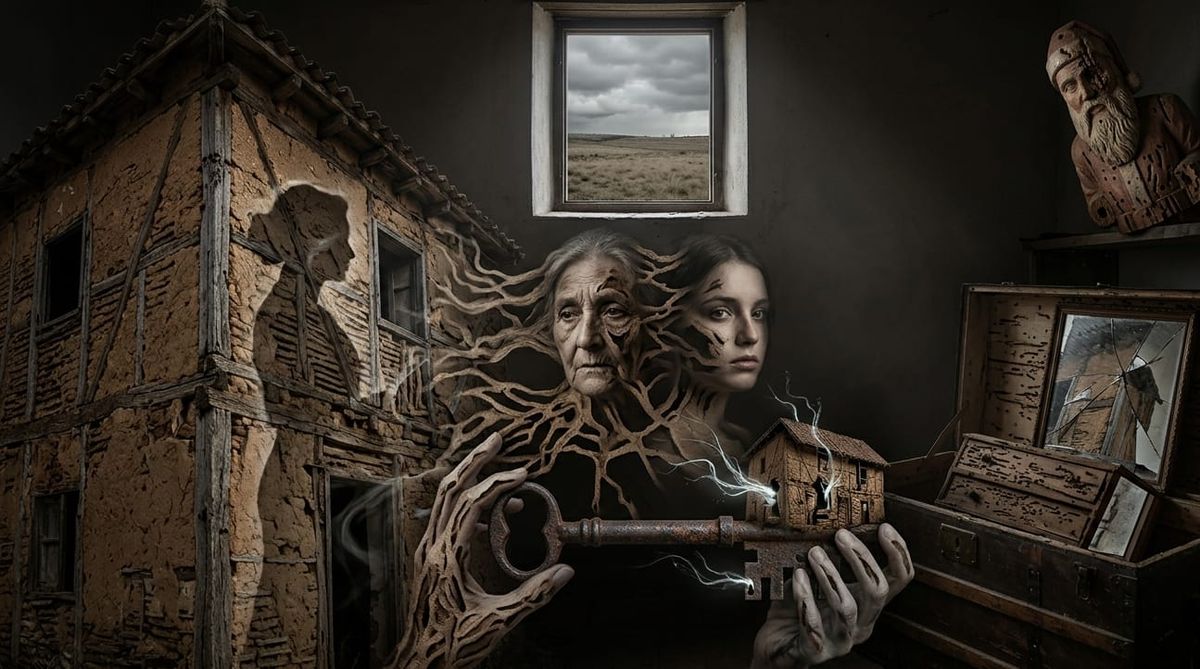
Most of the Gothic tradition makes a setting of a house. Carcoma refuses to. The walls here are not metaphorical containers. They are the bricks behind which, by the closing pages, three bodies are found leaning: a man, another man, and a child of about a metre's length. The house has been keeping its books. What looks at first like the rural-gothic furniture of a Castilian páramo (the saint-cards taped to the headboard, the shadows that live behind the cupboards, the grandmother who talks to what is in the wardrobe) is, by the end, a ledger. The supernatural register names debts. Every voice from the bricks corresponds to a body somebody buried, and every body buried corresponds to a man who, in the granddaughter's verdict, "vivía de las mujeres" - lived off women. Martínez's house does not haunt. It accounts.
The structural decision is austere and political at once. To make a building an agent rather than a setting is to refuse the consolation that gothic fiction has historically offered: the past as something seeping, drifting, atmospheric, present as mood rather than as evidence. Carcoma will not do mood. Its páramo is not pictorial. The house is not described before it acts; it acts, and the description follows. "Mi madre decía que esta casa hace que se te caigan los dientes y se te sequen las entrañas." My mother used to say that this house makes your teeth fall out and your entrails dry up. The verbs are physiological. The house is a body that takes apart other bodies.
The granddaughter, returning to the village after an unspecified incident with the local rich family, finds the grandmother under one of the beds. The grandmother is not demented, although a neighbour told the journalists that she was. A neighbour, the granddaughter notes, who had hair filthier than the deep-fryer of a roadside bar. Two registers, sacramental and vulgar, collide in a single sentence and stay collided for the length of the book. The collision is the voice. Martínez does not soften the granddaughter's anger into literary distance, nor stylise it into folkloric affect. She lets it talk.
Behind the wardrobe, behind the brick the grandmother eventually moves, the accounting becomes literal. The figures leaning against the wall are not, in the rural-gothic vocabulary, spirits. They are men, plus a small one. The phrase "esperar de la hija de un putero que vivía de las mujeres" - what to expect of the daughter of a pimp who lived off women - is the moral work the novel refuses to do in argument and does instead in plumbing. Lived off them, used them, used the village's silence as protection. The granddaughter looks. The light from her torch moves across the three figures. She replaces the brick, dusts the plaster from her hair, and gets back into bed. There is no scene of catharsis. There is no exorcism. The dead are simply there, behind the wall, where they have been, and the house has been keeping the receipt.
This is what the supernatural register is for. Read by impatient critics, the saint-cards and the angels and the santas que se aparecen en el techo de la cocina - saints that appear on the kitchen ceiling - look like atmosphere. Read closely, they are infrastructure. The granddaughter's bed is patched with images of the ángel de la guarda watching two children about to fall off a cliff: the children, she says, smiling like idiots, as if they were in their own yard rather than at the edge of the rocks. The image is comic and tender and politically exact. Protection is what the village did not provide. The angels, then, are the bookkeeping that the institution refused to do. When the saints appear, they appear because nobody else came.
The grandmother's voice, when it takes over, makes this explicit. She speaks to the shadows. She names them. She describes what each one wants, what each one was, what each one is owed. The cupboards, in this novel, are not metaphors for repressed memory. They are storage. Real storage, of real bodies of grievance, organised the way an old house organises everything else: by sediment, by what was put in last, by what got pushed to the back. The granddaughter inherits the cupboards, the way she inherits the bed, the resentment, and the bad blood. "Aquí lo que nos dejan los muertos son las camas y el resentimiento." Here what the dead leave us are the beds and the resentment. This sentence is, structurally, the spine of the book.
The grandmother's voice does the accounting more bluntly still. "Mi bisabuela murió porque se la comió enterita el odio, igual que a su marido. Él acabó emparedado en la casa que había construido para encerrarla a ella." My great-grandmother died because hatred ate her whole, same as her husband. He ended up walled up in the house he had built to lock her up. The sentence rearranges the gothic-tomb cliché into something colder. The house is not haunted by an injustice the architect did not foresee. The house is the architecture of the injustice itself, with the architect now inside it. The lock is reversed, but the lock is the same lock. Earlier in the same voice, when the grandmother's own mother dies, the grandmother tips the gravedigger to bury the coffin upside down so the dead woman, if she tries to come back, will know what is waiting. The rites are reversed not as transgression but as procedure. The procedure is the point.
The line is also where the novel stops being only Martínez's and starts to ask its question of the reader. There are inheritances that come as objects (gold rings, embroidered linens, the kind of thing literary fiction has been content to ennoble), and there are inheritances that come as furniture and bad blood, which is what most people actually receive, if they receive anything. Carcoma makes a claim I have sometimes been slow to make on my own behalf: that the bedframe and the resentment are not lesser bequests, only more honest ones. The polite story about loss tends to want a gold ring, or its equivalent in elegant elegy, even where the actual estate is a mattress and a grievance.
I can read the granddaughter's line in Castilian, but I can also hear it in another register. The displaced inherit objects with no provenance, languages they did not choose, beds whose previous occupants are not always named. The grandmother in Carcoma is the woman who knows the names. The granddaughter is the woman who has come back to find out what was, in fact, left to her. The novel is on the side of the second figure: the inheritor who did not want a story, but who also will not accept the version where there is nothing in the wall. What the inheritor does, in such cases, is to refuse two stories at once. The first is the story in which the inheritance was clean: comfort dressed as memory. The second is the story in which there was no inheritance at all: a different comfort, dressed as detachment. Carcoma declines both. The granddaughter finds the bricks, looks at what is behind them, and then puts them back. The bricks, after all, are also part of what was left.
What Martínez refuses, and what is harder to refuse than it looks, is the aestheticisation of this kind of inheritance. There is a long literary practice of taking the rural female grievance and rendering it as atmosphere - the dignified survivor, the granite-faced abuela, the village patient with its losses. The Carcoma grandmother is not patient. She kicks. She locks her granddaughter in a room. She talks back to the saints. The novel will not let the reader make her picturesque. The grievance is real, and it is also coarse, and it does not lend itself to the kind of melancholy that a more obliging book might supply. Carcoma declines the comfortable melancholy of a house full of women patiently bearing what was done. It supplies, instead, three bodies behind the bricks and a granddaughter who looks at them with a torch and goes back to bed.
The prose makes its argument at the level of the sentence. The book is somewhat organised around two voices, between nieta and abuela, with no chapter titles, no thematic naming, no thresholds offered to the reader. Within a section, the paragraphs are long, sometimes pages without a break. The effect is that of a body talking without permission to stop, which, structurally, is what the village did not give either of these women. The book asks its readers to receive speech the way the village did not. The register is oral and Castilian and unembarrassed. The granddaughter says vieja de mierda(old shitbag) about the grandmother she has come to look after, and the grandmother is not sentimentalised by the affection in the slur. The collision of registers is constant. The sacred furniture (saints, angels, blessings, the Diablo of the dedication) sits next to a roadside-fryer comparison and a description of hair gone greasy after two hours. Elegance, in this book, would be a kind of complicity. The metaphors do not arrive ornamented either. The house lunges, the entrails dry up, the bed inherits resentment. There is no recourse to a lyrical mode, no passages where the prose pulls back into a description of light on the páramo, no atmospheric long shots that would soften the matter. Carcoma is what is left when you remove from rural Spanish writing the consolations the genre has habitually offered: the silence as dignity, the landscape as soul, the saint as decoration. What remains is a building, a grievance, a torch, and a brick.
The novel dates itself. "Mantuvieron la casa a salvo durante tres años de guerra y cuarenta de posguerra," the grandmother says — the shadows kept the house safe through three years of war and forty of post-war. Three and forty. The Civil War and the long Francoist aftermath are not the background but the period in which the house's accounting was kept up. The paseos are in the book; the dawn knocks at the door are in the book; the cliff over which the local Francoists threw a few - "por allí despeñaron a unos cuantos, por el barranco de la ermita" - is in the book. The local rich family who survived and prospered, las Adolfinas, are described in one sentence that does the political work most novels need a chapter for: "esa guerra iban a ganarla ellas y la gente como ellas." That war was going to be won by them and people like them. The class allegiance and the political allegiance are the same allegiance, and the largest body behind the wall belongs inside this period. The man who lived off women was bricked up by his own wife not as metaphysical revenge but because he was trying to dodge the front. He had built a hidden chamber behind the wardrobe to wait out the war, and his wife, the granddaughter's great-grandmother, sealed the small opening with brick and lime when his threats from inside grew loud enough that the neighbours might hear. He was the patriarch, the exploiter of women, and the man too cowardly to face the war his class was winning. The three were one. The granddaughter's generation inherits the structure intact: the work available in the village is to mind the child of los Jarabo, the rich family of the day, or to clean an old man's house until he dies, or to do a few weeks of vendimia in season. The great-grandmother had refused to servir and had become a seamstress instead, but pride has costs the next generation pays. Carcoma is, at this level, a record of the labour options the Spanish countryside offered women: serve, marry into service, become unmarriageable enough to be called a maldecidora, or find another woman willing to brick up a husband. The novel does not soften the list into freedom. It is the list.
The novel sits within at least two pressures that earn their place. The first is the literature of the España vaciada, the emptied Spain - the pressure named, and somewhat aestheticised, by Sergio del Molino's La España vacía (2016). Martínez writes from inside that geography but refuses its melancholy framing. The village in Carcoma is not depopulated as elegy; it is depopulated because the people who built its silences are still inside the walls of one of its houses, and the women are the ones who never left. Pilar Adón writes contemporary Iberian gothic with women at the centre too, in a more contemplative register; the kinship with Martínez is in the project, not the rhythm. The second pressure is older and not Iberian. The image of bricks behind which the dead are kept, of a house that will not let go of what was done in it, has its strongest contemporary precedent in Toni Morrison's Beloved (1987). The 124 Bluestone Road of Beloved is a building that holds an account of an unbearable act. Martínez is doing the same operation in a Castilian páramo. The settings could not be more different; the structural move is the same. A house is asked to hold what the institution refused to record, and the haunting is, in fact, the record.
The novel ends on the smallest possible domestic act. The granddaughter replaces the brick, dusts the plaster off her pyjama trousers, helps push the wardrobe back against the wall. The grandmother turns out the bedside light. The cats are heard outside in the backyard because it is hot and they are not sleeping inside. The house, which lunged at the granddaughter on the first page, lets the two of them go to sleep. What is held is the brick. What is held is the bed. What is held is the mother who was never named, the man who lived off women, the village that watched and did not say. The light goes off, and the receipt remains.
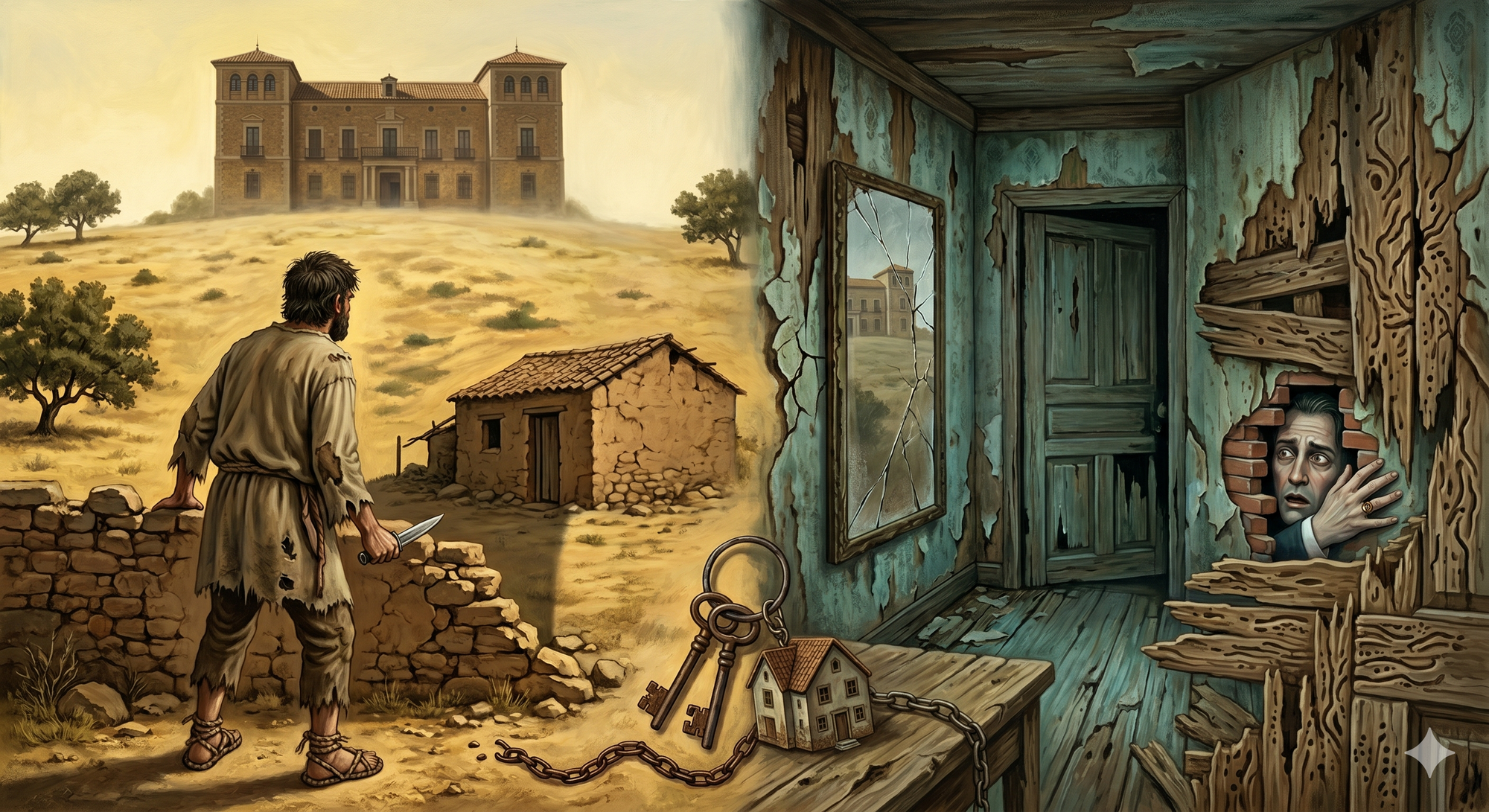
For an out-of-scope follow-up: the figure of las Adolfinas in Carcoma and the figure of the señoritos in Cela's La familia de Pascual Duarte (1942) is my sideways glance on the Castilian rural-bourgeois class as the same class twice.