On Philippe Collin's The Barman of the Ritz
Every Sidecar mixed to Meier's specifications is a kind of unconscious memorial to the fact that beauty has no politics, or rather that it is indifferent to them, and this indifference has always been beauty's most troubling quality.

The Grey Service
Hemingway is responsible for the epigraph: "Lorsque je rêve de l'au-delà, du paradis, je me trouve toujours transplanté au Ritz, à Paris" — whenever I dream of the beyond, of paradise, I find myself transported to the Ritz, in Paris. Philippe Collin takes this famous reverie and places it at the opening of his 2024 novel not as endorsement but as provocation: what if paradise were occupied? What if you dreamt your way into the beyond and found it full of men in field-grey with their boots polished and their appetites intact? The Hemingway epigraph, then, is less an enticement than a trap - the same trap that closed around Frank Meier, the Ritz's legendary head barman, on the 14th of June 1940, when the German Army entered Paris and the hotel on the Place Vendôme, alone among the great institutions of the city, remained open.
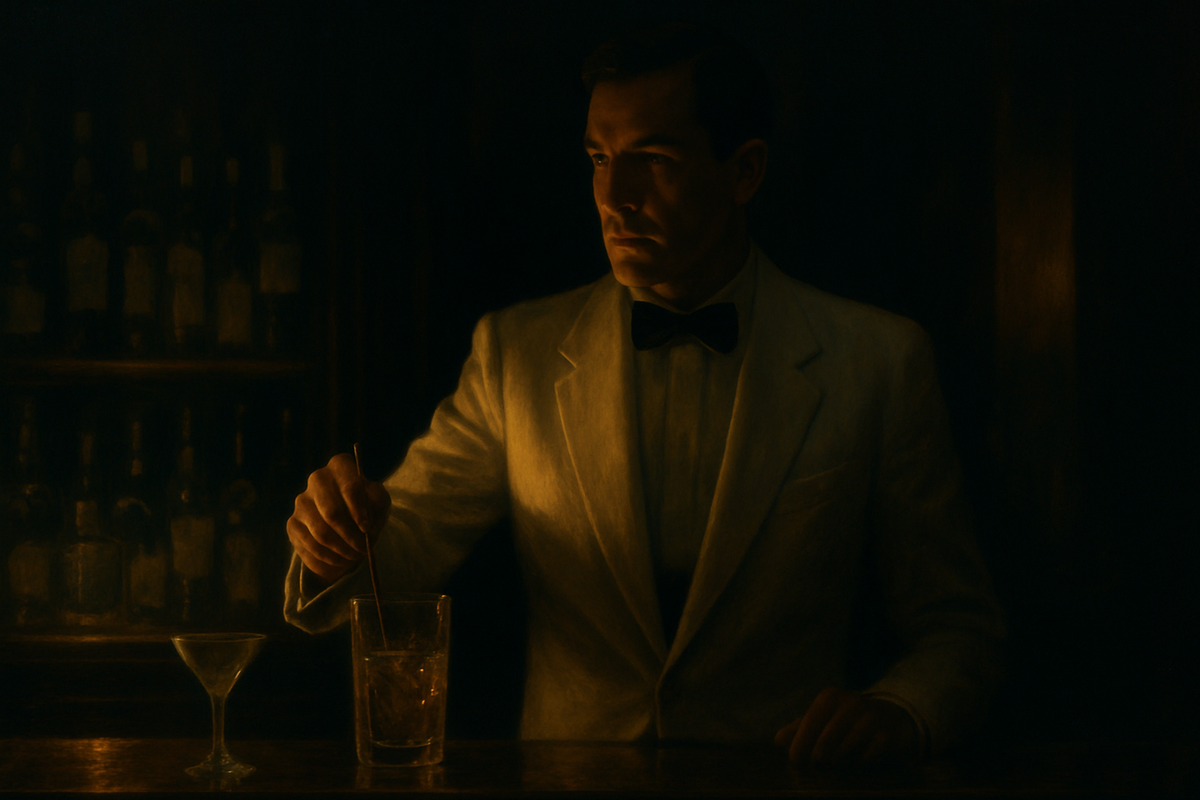
Picture the bar itself, which Collin renders with the fidelity of a man who has spent long hours in its company: le comptoir lustré, les boiseries en acajou, le cuir des abat-jour, le velours céladon des fauteuils Louis XV — the polished counter, the mahogany panelling, the leather lampshades, the celadon velvet of the Louis XV armchairs. The décor, Collin notes, had not changed since the bar's creation. It would not change during the Occupation either. This is the book's opening image of complicity: not a dramatic betrayal but a persistent sameness, a room that continues being exactly what it was, with different men drinking in it.
Frank Meier, behind that counter, is Collin's true subject. Austrian-born, son of Polish Jewish workers who had fled Lodz and the pogroms to settle in Vienna's Favoriten district, Meier had left Europe entirely in 1898, made himself in New York, crossed back, made himself again in Paris, published The Artistry of Mixing Drinks in 1936 to a celebration that gathered the Duke of Windsor, Churchill, Chanel, Hemingway, and Fitzgerald. His clientele was, by his own account, la crème de la crème; his bar, le fief des suzerains de la nuit. And then, in June 1940, France dissolved - Collin's sentence for this is as precise as any he writes: La France s'est dissoute comme un morceau de sucre dans un verre d'absinthe("France had dissolved like a lump of sugar in a glass of absinthe"). Meier stayed. The bar opened. The new clients arrived.
Le Barman du Ritz - and this is the first thing to understand about it - is a novel. Collin declares this in his opening note with an honesty that is itself a literary act: "Le Barman du Ritz est un roman qui s'appuie sur des faits et des personnages réels." A novel that rests on real facts and real characters. The journal entries that punctuate the narrative - written in Meier's first person, moving between his childhood, his years in America, his memories of the previous war - are Collin's invention, offered as homage to "ce destin hors du commun." The third-person narrative, written in the present tense of the Occupation years, reconstructs scenes and conversations that no archive could preserve.
This formal declaration does something morally important. It frees Collin from the pretence of documentary authority while holding him to a different standard: the standard of imaginative truthfulness. He is not Meier's biographer; he is Meier's novelist. The distinction matters because it changes what we are reading. The first-person voice in the journal entries is not testimony; it is ventriloquism - Collin's act of inhabiting a man whose interiority no one can know. This is an act of both generosity and appropriation, and the book's best quality is that it seems to know this. Collin's prose does not pretend to certainty it cannot have. His Meier equivocates, contradicts himself, arrests his own thoughts mid-sentence. The voice of the journals is not the voice of resolution; it is the voice of someone still sorting through what he did, without being fully able to say what that was.
Formally, Collin alternates these two registers - the invented journals in first person, the novelistic narration in close third - with the ease of a man whose career in radio has accustomed him to voices rather than texts. The sentences have been shaped by the knowledge that they might be heard rather than merely read: clean, arriving without subordinate clause excess, rhythmically spare. Whether this is a formal achievement or simply the natural disposition of a journalist turning novelist, the effect is of a prose that serves the material rather than displaying itself. Meier's story does not need embellishment; it needs, and gets, attention.
What the actual text reveals - and here a reading of the novel changes what criticism can say about it - is that Meier's position was considerably more complicated than the simple binary of staying versus leaving. Behind the counter, and sometimes at cost to himself, he ran a small operation producing faux papiers: false passports for Jewish refugees, channelled through a hotel functionary who operated on the margins of danger. Collin's Meier notes with discomfiting honesty that he charged for this service, and that he sometimes wondered, looking at himself in the mirror, whether he was a profiteur de guerre - a war profiteer - as much as anything else. The resistance was real; the profit was real; neither cancels the other. This is not the barman as pure collaborator nor as secret hero. This is the barman as a man navigating, imperfectly, with one eye on his conscience and the other on his survival.
The moral weight arrives most plainly not in the daytime scenes - the drinks ordered, the deference extended - but in the sleepless nights. There is a passage, roughly a month into the Occupation, where Meier lies awake at three in the morning, turning over what he has become: "Bientôt un mois que les Allemands sont là, et qu'ai-je fait ? Je suis devenu exactement ce que je voulais éviter. Bonsoir messieurs ! Un Rum Fizz, mon lieutenant ? Sourire aux Allemands, ça vous ronge de l'intérieur." - Almost a month the Germans have been here, and what have I done? I've become exactly what I meant to avoid. Good evening, gentlemen! A Rum Fizz, my lieutenant? Smiling at the Germans eats you up from the inside. The sentence rhythm here does something that summary cannot: the descent from formal self-accusation into the performed greeting, then the final verdict. Ça vous ronge de l'intérieur. It eats you up from the inside. It is the most precise sentence in the book about what surviving in proximity to evil actually costs.
And then, on the way to a dinner with Colonel Speidel at Bagatelle - an invitation he accepts, another accommodation - Meier passes through streets of hungry, resigned Parisians and has a thought he cannot finish: "Si j'étais à leur place, je détesterais un type comme moi" - If I were in their place, I would detest someone like me. The sentence is allowed to stand without commentary. Collin trusts the reader enough not to explain it.
A junior colleague at the hotel, watching the world outside, gives the Ritz itself its most apt description: le bunker du glamour - the bunker of glamour. Two words that enclose what four years of Occupation inside a luxury palace actually felt like: the warmth, the champagne, the continued performance of elegance, and the war pressing in on every side.
The book is structured to deliver its real blow at the Liberation. In August 1944, Meier waits at his bar as the Allied forces enter Paris, not knowing whether the men who come through the door will want a drink or will want to arrest him. He has burned, in his kitchen sink, the letters from a German contact who had been part of the anti-Hitler conspiracy - letters that might have testified to his equivocal loyalties. But they were only poems - Goethe and Schiller - and would have proved nothing. What he cannot burn is how it looks. Collin writes it as Meier finally understands it: "Pour le monde entier, et les FFI en particulier, Frank Meier est resté pendant quatre ans le barman de l'armée allemande et des collabos. L'ironie du destin est bien cruelle." - In the eyes of the world, and of the FFI in particular, Frank Meier had spent four years as the barman of the German army and the collaborators. The irony of fate is deeply cruel.
He was arrested. He was interrogated. He apparently bought his release for three hundred thousand francs paid to the French Forces of the Interior. He was probably fired from the Ritz in 1946, for reasons that remain unclear. He died in 1947, under circumstances that Collin's historical notes call mystérieuses and leave there. He is buried at the cemetery of Pantin, in the northeast of Paris, beside his ex-wife and the son he had never quite known how to love.
None of this appears in the narrative proper. It comes in brief annexe entries after the fiction has ended, set alongside the fates of Speidel, Jünger, the Stülpnagels, Chanel - the full cast of the occupied Ritz. The effect is quietly devastating: the novel restores Meier to complexity, and then history reduces him again, this time not to collaborator but to footnote. The man who stayed, who watched everything, who served everyone, who carried what he carried - his end is mystérieux. His grave was not known for decades.
I have been sitting with this for weeks, and the image that will not leave me is the burning of the letters. Not the grand gestures - the false papers, the small acts of resistance, the refusal to be openly servile - but this: a man destroying his own alibi because he has calculated, correctly, that it would not help him anyway. The gesture belongs to a category I recognise from my own practice of photography. The question I cannot resolve, and that Collin's book sharpened rather than answered, is the one my own work poses every time I raise a camera at someone in a condition of diminishment: is the image I am making an act of bearing witness, or am I making the difficulty beautiful enough that the discomfort passes? The photographer and the novelist are in structurally similar positions. Both frame a subject who cannot frame themselves. Both must reckon with what framing does. Collin's Meier burns his letters because he knows that any frame someone else puts around them will be wrong. He has spent four years being framed - by the uniform of the men he served, by the institution that housed them both - and he knows, at the Liberation, that there is no frame available to him that will render the truth of what he actually was.
This is what the book cannot do either, and knows it cannot do. The liminary note that declares it a roman - a novel - does not resolve the question of what Meier deserves; it relocates it. Collin has made the most careful, most honest frame he could - and the man inside it remains, deliberately, opaque.
The moral ambiguity that most occupied histories of the Occupation try to stabilise - to resolve into a chart of resisters, collaborators, victims, bystanders - Le Barman du Ritz holds open, refuses to close. The question Collin is really asking is not whether Meier was good or bad. It is whether excellence can be separated from context, whether craft is ever morally neutral, whether the man who mixes the finest cocktail in Paris for the occupier is doing something different from the man who mixes it badly. The incompetent servant gives the occupier bad service. The gifted one gives him something to return for. Ça vous ronge de l'intérieur. But you continue. And four years later, you burn your poems in a kitchen sink in a city that has decided what you are.
Hemingway and Robert Capa, Collin tells us, raced each other to the Ritz at the Liberation, both determined to arrive first, to drink at the bar of paradise reclaimed. What they found there is the question Collin's novel, published eighty years after that August day, has been patiently reconstructing. Not paradise. Not its opposite. Something more difficult: a man who had stayed, who had smiled, who had served, who had helped where he could, who had profited where he could, who had loved his craft more than his conscience sometimes permitted, and who now stood at his polished counter, wondering if the men who were coming would drink with him or destroy him.
They drank with him. His recipes survive. The Ritz still serves them. The moral reckoning does not.