Jarales / Jarabo: the rural-bourgeois patron in two Iberian novels
An asymmetric comparison of Camilo José Cela's La familia de Pascual Duarte and Layla Martínez's Carcoma (2021).

A name rang a bell, and that simple echo led to what follows.
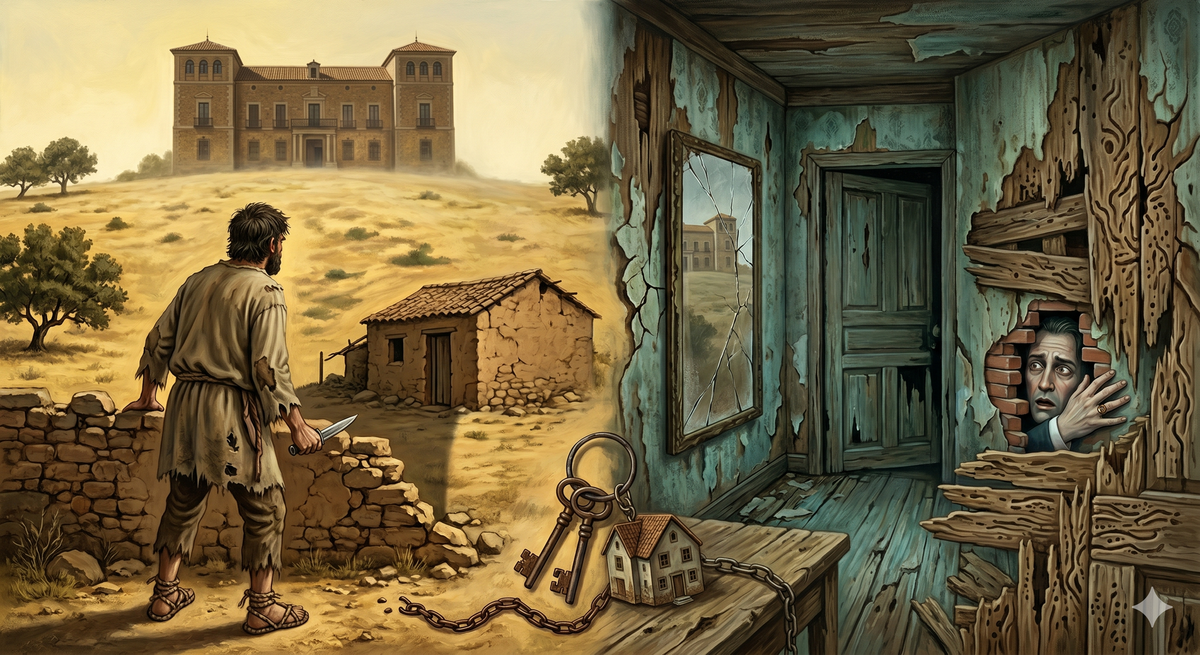
In Camilo José Cela's La familia de Pascual Duarte (1942), the rural-bourgeois patron is don Jesús González de la Riva, Conde de Torremejía, owner of an estate called la finca de Los Jarales. In Layla Martínez's Carcoma (2021), the rich family in the village is los Jarabo, and the granddaughter has worked for them as a child-minder. Whether Martínez intends a deliberate echo or whether Iberian rural fiction simply reaches for the same vocabulary when it names this class, the figure is the same - the rural-bourgeois patron of the meseta and Extremadura, the señorito and his estate, the family that owns what is owned and that the village is structurally arranged around. Eighty years and two regimes apart, the two novels show this class twice. They show it differently. They show it in different registers, addressed to different readers, mediated by different relations to power. The comparison is not symmetrical. It is the asymmetry that makes it useful.
Both novels have a man of, or aligned with, this class killed by a person of the lower class during the Spanish Civil War. In Cela the man is don Jesús himself, and the killer is Pascual Duarte. In Martínez the man is the bisabuelo, the puterowho tried to dodge the front, and the killer is his own wife, who builds him a hidden chamber behind the wardrobe and then, when his threats grow loud enough that the neighbours might hear, seals the small opening with brick and lime. Two killings during the same war, by people of the lower class, of men aligned with the rural-bourgeois class. The structural symmetry stops there.
In Cela's novel the murder of the patron is not in the manuscript. Pascual writes his memoir in the prison at Badajoz. The memoir's climactic act, the one rendered in the most physical detail, is the murder of his mother on 10 February 1922: the matricide, the long fight on the bed, the throat opened with the cuchillo de monte whose blade resembles maize leaves. The manuscript ends there. What Pascual did to don Jesús, fourteen years later, in the fifteen days of revolution that briefly passed over the village in 1936, is described nowhere by Pascual himself. The transcriber tells us so, in his second editorial note, with care: "si hacemos excepción del asesinato del señor González de la Riva - del que nuestro personaje fue autor convicto y confeso - nada más, absolutamente nada más, hemos podido saber de él". With the exception of the murder of don Jesús, of which our character was convicted and confessed, nothing else, absolutely nothing else, has been possible to learn. The political act is the act we are not allowed to read.
The displacement is the political fact of the novel. The Francoist regime under which Pascual Duarte was published in 1942, and which would, the following year, employ Cela himself in its censorship apparatus, could tolerate a novel about a peasant who kills his mother. The matricide is moral horror, brutality, tremendismo; it confirms the regime's view of the rural classes as creatures requiring patrician supervision. The murder of the local conde during a revolutionary moment is something else. It is a class act in a political opening that the regime closed within weeks. To put that act in the peasant's own voice, in detail, with motive (to let Pascual say why he killed don Jesús) would be to publish a book the regime could not publish. The book solves the problem by ending the manuscript before the political act and leaving the patron's death to the editorial apparatus. Pascual confesses what is private; the public act is rumoured by his guard.
In Carcoma, no comparable displacement. The grandmother tells the bricked-up husband directly. There is no editorial frame, no transcriber, no addressee outside the book. "Mi padre se quedó dentro y mi madre enyesó y encaló la pared con esmero, como se hacen las tareas importantes." My father stayed inside and my mother plastered and limed the wall with care, the way important tasks are done. The work is named as work. The class allegiance of the man - las Adolfinas, the local rich family in those years, are described as already understanding that "esa guerra iban a ganarla ellas y la gente como ellas" - is named. The 2021 novel does not need to displace its own central political act. The novel of 1942 cannot afford not to.
The two endings make different things possible. In Cela the patron's death produces a manuscript and a death sentence. The peasant goes to the gallows for the act the manuscript has already excluded; the manuscript itself becomes the object that survives him. In Martínez the bisabuelo's death produces no manuscript and no sentence. It produces a household. The wife sells the furniture, becomes a seamstress, and her daughter is born five months later in the same room where she walled up the man. The granddaughter, in the present-time of the 2021 novel, inherits the household and the wall. What survives in Cela is the writing. What survives in Martínez is the architecture. Both are records, but only one of them required the patron-class's permission to reach you.
The registers do this work. Tremendismo, the post-Civil-War realism of which Pascual Duarte is the founding text, is what the regime accepts. The matricide scene is detailed in a way that a different kind of novel would consider unpublishable: "la sangre corría como desbocada y me golpeó la cara. Estaba caliente como un vientre y sabía lo mismo que la sangre de los corderos." The blood ran like a runaway horse and struck me in the face. It was warm as a womb and tasted the same as the blood of lambs. Bodily detail, peasant simile, the violence of the rural underclass rendered without softening. The censor passes it. The regime publishes it. Tremendismo is not the form that resisted Francoism. It is the form Francoism could absorb: peasant brutality is an ethnographic fact about the lower classes, not a political indictment. The same regime that lets the matricide be published in this register would not let a Pascual write, in the same register, why he killed don Jesús.
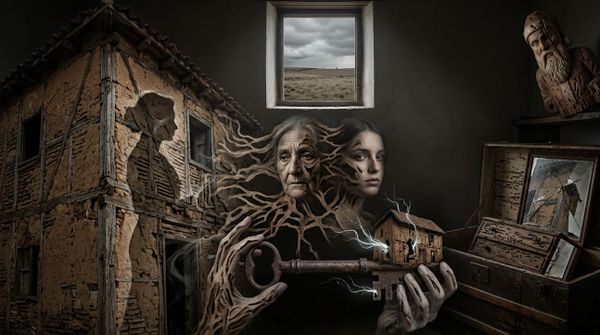
The Gothic register Carcoma uses is also a strategy, though for a different problem. By 2021 there is no censor to evade. The Gothic ledger (saint-cards, shadows in the cupboards, bricks behind which the dead are kept, the granddaughter's torch in the wall) is doing political work, but the work is not concealment. It is form. The rural-bourgeois oppression of women in 1936 and 2021 is recorded in a register that lets the supernatural carry the accounting because the secular has refused to keep the books. The literary apparatus that did keep books, in 1942, was the apparatus of patron-class confessing through transcribers. The literary apparatus that keeps books in 2021 is shadow, brick, household. The forms have changed because what is allowed has changed.
To compare tremendismo and Gothic ledger as if they were two equivalent literary choices is to ignore what made one of them publishable. They are not equivalent. Cela writes from inside the regime that would shortly employ him; the form he reaches for is a form the regime can accept. Whether he intended this or not is, for the form's effect, beside the point. What was published in 1942 had to be a form the censorship apparatus could read as ethnography rather than as politics. Martínez writes from outside, from a politically opposed position and a small left publishing house she co-founded, in a year when the apparatus does not need to be evaded. The form she reaches for is the form she chose, not the form she could publish.
Don Jesús's house is on the village plaza, and Pascual describes it early in the manuscript with the kind of attention a peasant would have given a building he was not allowed to enter freely. It has two storeys; most others have one. The façade is "del color natural de la piedra, que tan ordinario hace, y no enjalbegada como hasta la del más pobre estaba" - the natural colour of the stone, which makes it look so plain, not whitewashed like even the poorest house in the village. The peculiarity is read by Pascual as a class signal: "sus motivos tendría", he must have had his reasons. Above the portal, stones of escutcheon, of great value, finished in heads of ancient warriors with helmet and plumes, "que miraban, una para el levante y otra para el poniente, como si quisieran representar que estaban vigilando lo que de un lado o de otro podríales venir." Looking one toward the east and one toward the west, as if to represent that they were watching what could come from either side. The patron's house is the one that watches the horizons. The villagers' houses are watched. Pascual's own house, two hundred large paces outside the village, is not on the circuit at all.
Inside Cela's novel, the class arrangement has its purest scene early on, and it is not violent. Pascual goes to the parish priest, don Manuel, to arrange his wedding. Don Manuel tells him to sit on a bench in the church during mass. The instruction is liturgical: "Cuando veas que don Jesús se arrodilla, te arrodillas tú; cuando veas que don Jesús se levanta, te levantas tú; cuando veas que don Jesús se sienta, te sientas tú también." When don Jesús kneels, you kneel; when don Jesús stands, you stand; when don Jesús sits, you sit too. The peasant's body takes its instruction from the patron's body, mediated by the priest. Religion, class, and physical choreography are aligned in a single sentence. Carcoma offers no such scene because the women in Carcoma do not attend mass on those terms; they keep their own santos, their saint-cards taped to the headboard, their reversed coffin in the gravedigger's tip. The 2021 novel has the village's church but not the village's choreography. What Cela's peasants must imitate, Martínez's women have walked away from. They have not necessarily walked into freedom. They have walked into a private bookkeeping that no longer takes its cue from the patron's knees.
The two memoirs reach the reader through different architecture. Pascual Duarte is wrapped in three layers of class-aligned mediation. Pascual writes his manuscript in the cell at Badajoz and addresses it not to a fellow peasant, not to a reader of his own class, but to don Joaquín Barrera López in Mérida, a man of the patron's class and a friend of don Jesús González de la Riva. Don Joaquín, on receipt of the manuscript, drafts a holographic will clause: "ordeno que sea entregado a las llamas sin leerlo, y sin demora alguna, por disolvente y contrario a las buenas costumbres." I order it given to the flames unread, without delay, as dissolvent and contrary to good customs. He stipulates only that, if Providence preserves the package for eighteen months without anyone's bad arts, the finder may keep it. The transcriber, who later finds the package in a pharmacy in Almendralejo in mid-1939, is the third layer. He admits, in his preface, to having "preferido, en algunos pasajes demasiado crudos de la obra, usar de la tijera y cortar por lo sano" - preferred, in some passages too crude, to use the scissors and cut to the quick.
So Pascual's voice reaches the reader of 1942 through a manuscript that should have been burned, that survived only by the providence of don Joaquín's clause, and that has been edited by an unnamed figure who tells us he has cut what he found too crude. The peasant's confession is filtered by the patron's friend, the prison guard, and the transcriber's scissors. The form is a hierarchy. The reader of Pascual Duarte is positioned in the place don Joaquín refused to take: the place of someone who reads what should have been burned. To read the book is, in 1942, already a small transgression performed under cover of a fiction that has prepared every excuse for it.
Carcoma has no comparable architecture. The granddaughter speaks. The grandmother speaks. They alternate. There is no transcriber, no addressee, no will, no scissors. The reader is not positioned as someone who reads what should have been burned. The reader is positioned as someone who, in 2021, has agreed to listen. The trust is direct, even when the voices are unstable. The grandmother in particular is unreliable in ways that hold the book open: her santos, her curse-bundles, her tipping the gravedigger to lay her own mother's coffin upside-down so the dead woman would know what was waiting if she tried to come back, are not always presented for the reader's verification. But unreliability is not mediation. The narrator can be wrong without the patron-class having had to vouch for her. Carcoma asks the reader to receive the speech of the women who never left the house. Pascual Duarte asks the reader to receive the speech of a man whose class and politics required three layers of permission to reach print.
The same class, twice. The first time, in 1942, the rural-bourgeois patron is killed during a revolutionary opening that closes within weeks, and the killing is excised from the manuscript that the killing produced: the manuscript that survives only because a friend of the patron stipulated it might. Los Jarales keeps its name; the peasant who entered the finca hangs at Badajoz. The second time, in 2021, the man aligned with the patron-class is killed inside the house his daughter and granddaughter still occupy, and the killing is told straight, in his own daughter's voice, with no transcriber and no apologia. Los Jarabo, in Carcoma, are alive and still hiring child-minders. The granddaughter has worked for them and come back with her unspecified incident, the only thing the novel will not name. The class is intact in the present, as the class was intact at the close of Pascual Duarte: don Jesús dead but the finca not dispersed, not seized, not reckoned with except as a tragedy in a transcriber's frame. The escutcheon stones above the patron's door are still looking, one east and one west, at what could come from either side. What has changed across the eighty years is not the patron's grip. It is who is permitted to write the receipt, and to whom.