On Umberto Eco's The Name of the Rose
We come to Il nome della rosa in 1980 expecting, on the cover's promise, a medieval murder mystery. We get one, and a fine one, with seven dead monks and a Franciscan detective and a great deal of Aristotle. But the book's engine is not the murders.
The Book Jorge Ate
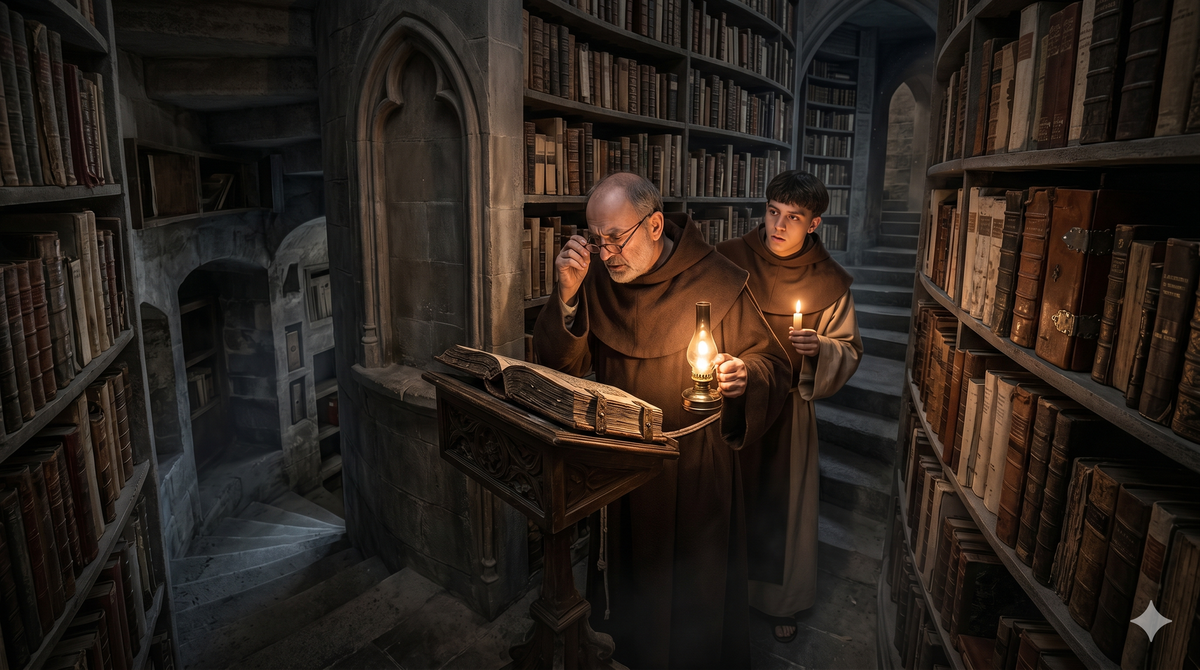
In the dark of the finis Africae, the blind man eats. Jorge of Burgos has guarded this room most of his adult life — the hidden chamber at the heart of an octagonal library whose architecture maps a cosmography no one outside the order is meant to read. Inside it, beneath layer after layer of administrative caution, is Aristotle's lost second book of the Poetics, the treatise on comedy. William of Baskerville has finally found the room, found Jorge, and found the book. Jorge, knowing the fight is over, takes the book in his hands and begins to chew. Page by poisoned page. The same poison he laid on it himself, decades earlier, to be certain that anyone who read those pages would die for the privilege. His own teeth blacken. His mouth fills. He swallows.
It is one of the most baroque images in twentieth-century European fiction, and it does not sit comfortably in the genre Eco appears to have built around it. We come to Il nome della rosa in 1980 expecting, on the cover's promise, a medieval murder mystery. We get one, and a fine one, with seven dead monks and a Franciscan detective and a great deal of Aristotle. But the book's engine is not the murders. The engine is the question of why an old, blind monk would rather eat a poisoned manuscript than allow it to be read. The novel asks that question for several hundred pages, takes its time arriving at the answer, and then leaves the answer for the reader to do something with.
The answer is laughter.
Jorge fears laughter the way the Inquisition fears doubt. Earlier in the novel, in one of the long disputations Eco writes with unembarrassed pleasure, Jorge stages the position formally: Christ never laughed. The Gospels record him weeping; they do not record him smiling. Laughter, Jorge argues, is a property of the carnal world, of comedy as the genre that cannot bear the weight of seriousness. To grant laughter theological dignity — as the lost Aristotle would have done — is to authorise a way of standing in front of the holy that does not stand straight. It is to admit that the categories of the system are not coextensive with the world they claim to govern. It is to introduce the gap.
This is what Jorge cannot survive. The gap between sign and world is the wound he has spent his life refusing. Aristotle, by giving comedy a structure, would teach readers to keep that gap open as a discipline. The absurd, properly handled, is not the enemy of the sacred but the instrument by which the sacred is kept honest. To laugh at a thing is to refuse to be coerced by it. To laugh at a thing is to remain in the question of what it is. Jorge eats the book because he has understood Aristotle better than William has. He prefers his own death, and the death of every monk who has tried to read those pages, to the diffusion of a literary form that authorises uncertainty. Comedy, taken seriously, is theological dynamite. The system does not survive the joke.
The novel does not let the comedy argument live inside a library only. Eco lets it touch the body. Bernard Gui arrives at the abbey in the middle of the seven days, with the slow inevitability of a procedure that has been on its way the whole time. He interrogates Salvatore — a half-feral monk whose speech is a private rubble of every dialect and dead language he has ever heard — and Remigio the cellarer, whose body has already begun, under the procedure's pressure, to remember itself as guilty. He condemns a peasant girl who happens to be in the room when he arrives, who answers her interrogators in a tongue none of them will recognise. She is sent to the fire without anyone in the room understanding a word she has said.
This is what Jorge's epistemology looks like once it has hands. The man who cannot bear the gap between sign and world will, in his secular cousin, fill the gap with verdicts. Where Jorge eats books to keep their ambiguity from spreading, Gui burns bodies to keep their ambiguity from speaking. Both are doing the same work in different uniforms. The novel's comedy is not the opposite of its violence; it is the alternative the violence cannot abide. The peasant girl burns precisely because she belongs to a register the procedure refuses to admit — a body, a tongue, a context that does not fit. Comedy would have given her room. Comedy is what the procedure refuses. Adso watches this and only half understands what he is watching. The reader knows. The novel's centre is not finally the labyrinth or the poisoned book. It is the small, dirty room in which conviction takes its handful of bodies while the great theological argument continues, in better light, upstairs.
Eco's prose is not pacing toward anything in the modern sense. The sentences build like Latin arguments: subordinate, citational, weighted with names — Augustine, Bonaventure, Aquinas, Roger Bacon, Joachim of Fiore — piled like stones at the foundation of a single point. To read Eco is to feel the seductive coherence of scholastic thought. The world clicks shut around you. Every sign points to a stable referent. Authority once cited has settled the question.
And then the prose laughs. Not visibly — Eco is too careful for that — but in the slight excess of erudition, the way Adso's Ciceronian gravitas keeps gesturing past itself toward something it cannot quite say. The novel is, at the level of its sentences, a kind of erudite comedy: a scholastic treatise that knows it is performing a scholastic treatise and that the performance is one of the things being examined. Eco, the semiotician, understood that no system describes itself without remainder. Eco, the novelist, made the remainder the book's centre. The form is the argument. The argument is that the system is not the world.
Comedy in the European tradition, including Cervantes, Sterne, Eça de Queirós, and Eco himself, is the genre of the broken frame, the literature of the gap. It admits, where tragedy cannot, that the human condition is partly ridiculous and that ridiculousness is not opposed to dignity but constitutive of it. Eça understood this in the nineteenth century, in Portuguese, with a scalpel disguised as a silk glove. Eco understood it in the twentieth century, in Italian, with a cathedral's worth of citations. Both writers refuse the false choice between seriousness and irony. Both know that to write seriously about the world, you have to be willing to be funny about your own writing. Jorge would have eaten Eça, too, if he could have caught him.
I came to the novel through Annaud's adaptation, which reached Portuguese cinemas in 1986 or early 1987. I was thirteen or fourteen. The film was the first thing of its kind I had seen on a serious scale — a medieval interior carried with adult gravitas, Sean Connery wearing William's intelligence as if he had been carrying it for decades, F. Murray Abraham's Bernard Gui filmed in such a way that the camera understood him before any of the other characters did, Ron Perlman's Salvatore as a creature whose tongue had already broken. Annaud could not keep the disputations, the citational density, the long philological arguments about what Christ did or did not do. What he could keep — and what he held with serious craft — was the face. The geometry of an interrogation. The colour of fire. The texture of a labyrinth filmed inside an actual building rather than dreamed on a soundstage.
Adaptations of novels of ideas are usually charged with what they cannot transfer. Annaud's film is honest about this. It does not pretend to render the philosophical argument; it renders the world in which the argument occurs. What it loses, the novel keeps. What it added was what sent me to the book shortly after, in an English edition I read as an adolescent who already knew how to handle a long sentence.
The book recognised me. The reading was the kind of reading that happens when a text confirms an instinct you already had — that the world is larger than its system, that conviction without doubt is the more dangerous kind, that books and bodies are the same currency in any apparatus that has stopped tolerating the gap. What changed across rereadings was not whether I understood the novel but which of its rooms I was sitting in. At sixteen, the labyrinth. In my twenties, the disputations. Later, the small, dirty room with Bernard Gui in it.
I have spent the years between then and now reading other writers who hold open the same gap, and they have, in turn, given me back the novel. Pessoa is the closest. The fragmentation of the Livro do Desassossego into voices that refuse to reconcile is a literary instrument for living within what Eco's novel describes. To read Pessoa is to discover that the self is not a system: it is a labyrinth one walks without a map, in which different rooms hold different selves, and the dignity of the practice consists in refusing to choose between them. Pessoa held the question open by multiplying voices. Eco held it open by writing a labyrinth. Both refused, in their different idioms, to become Jorge.
Photography, in the years it has been my second discipline, has given me a vocabulary for what William of Baskerville is actually doing. William's spectacles are not a detective's prop. They describe what attention is. The Franciscan's whole method — Eco's anachronistic gift to him, half Roger Bacon and half C.S. Peirce — is the discipline of looking at a sign and refusing to know what it means until the world has had its chance to surprise you. He notices a horse's hoofprints, the angle of a door, the position of a manuscript on a desk. He builds nothing on the first observation. He waits.
A camera works the same way. The frame is not a verdict; it is an invitation to look at a small piece of the world long enough to discover that you do not yet know what it is. Some photographs only appear when you have stayed in a place past the point your impatience would have moved you on. The cleaner pausing in the airport corridor, the man waiting on the bridge, the reflection that holds the city upside down for a half-second — these are the moments William would have noticed. They reward the slow eye. Jorge could not have photographed anything. The camera presupposes a reverence for the gap.
I am rereading the novel now, four decades after the film, in the Gradiva edition, in Portuguese. The language has done something I did not expect. The English in which I first read it carried Eco's Latinity at a slight remove. Portuguese, on its own Latin spine, holds the cadence of the disputations more easily. The quaestio feels native to the prose; the citations sit where they would have sat in a Romance original. I had not expected the language of my own life to make Eco's medieval Italian feel less like a translation, but it does. Whatever else rereading is for, this is one of the things it is for: a book finds, over time, the language that was there to receive it.
The library burns. The labyrinth collapses. The murderer is consumed by his own apparatus. Most of what Adso came to the abbey to learn is destroyed in a single night, including the only known copy of Aristotle on comedy. The novel ends not with restoration but with ash, and with an old man's manuscript composed in the cold of a German monastery, written by someone who knows it will be lost, miscopied, mistranslated, and finally surface centuries later as the suspect document of the prologue's elaborate joke.
This should be unbearable. The novel makes it almost cheerful. Adso writes anyway, knowing he will be misread. William's late lesson to him — that the only honest response to the world is to free oneself from the love of truth, since the love of truth, taken as Jorge takes it, becomes the procedure that produces fires — is offered without consolation and without despair. It is, in its own way, comic. Not because the situation is funny, which it is not. Because the only adequate response is the kind of laughter that does not require anything to be settled before it can sound.
Forty-some years on, the novel reads to me less as a period piece than as a manual. The procedures Eco anatomises have not retired; they have changed costume and accelerated. We now live inside fluent text-producing systems that have no stake in whether what they say is true, organised by an internal cosmography that most of their users can no longer articulate. Algorithmic feeds collapse the surplus that the world keeps offering them. The categories of the platform are presented as coextensive with the world they purport to describe, and disagreement, in the platform's logic, registers as a routing error. Jorge would have understood this architecture immediately. He would have approved. What he feared — what we have largely abandoned — is the discipline of the slow eye: the hour spent on the sentence that does not yet make sense, the photograph that requires the photographer to wait while nothing happens, the book read at the pace of breathing. These are not nostalgic practices. They are the techniques by which a person stays larger than the system that wants to manage them.
The novel's closing Latin — stat rosa pristina nomine, nomina nuda tenemus — has often been read as a melancholy benediction. The first rose remains only in name; we hold mere names. But Adso writes the line at the end of a long life spent inside the question, and the line is also a kind of grim joke: the philologist's last laugh, the recognition that what we get to keep is not the thing but the name we keep careful enough not to misuse. Jorge could not have laughed at the line. William, I suspect, would have permitted himself a small one.
The library is gone. The treatise on comedy was never reconstructed. What survives — and this is, in the end, what Eco was offering — is the willingness to keep reading, and looking, and naming, slowly enough that the world has time to remain larger than the procedure designed to convert it.
The dark room is empty now. The book is in the blind man's stomach. Somewhere, a young monk is writing it down anyway.