
Klara and the Sun, by Kazuo Ishiguro
A remarkable philosophical inquiry into the boundaries of consciousness, love, and human experience.

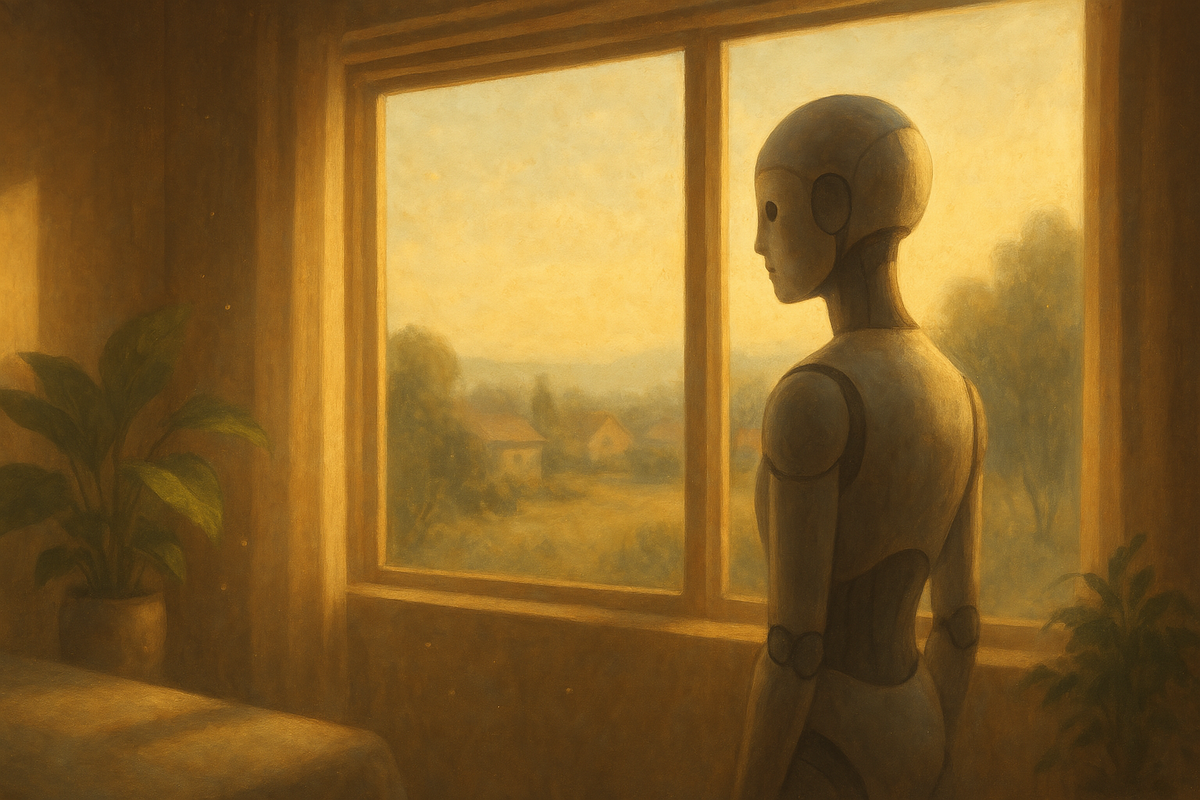
A Quiet Novel of Radical Questions
I have long been a devoted reader of Kazuo Ishiguro, and one of the enduring pleasures of his fiction is the way he can make emotional restraint feel almost unbearably intimate. Klara and the Sun does this with particular elegance. On the surface, it is a speculative novel about an artificial companion and a sick child, set in a near-future world shaped by biotechnology, managed childhoods, and the possibility of engineered replacement. But that description barely begins to capture what the book is doing. Ishiguro has written a quiet, unnerving, and deeply humane meditation on consciousness, love, substitution, and the fragile terms on which we grant one another personhood.
What I admire most is that the novel never turns Klara into a mere device for philosophical argument. She is not a gimmick, and she is not simply a symbolic robot standing in for an abstract debate about artificial intelligence. She is a fully realized narrative consciousness, one whose perceptions are limited in ways that become meaningful rather than frustrating. Because Klara sees the world with such literal attentiveness, every human gesture, silence, and contradiction acquires moral weight. Ishiguro uses that distance not to reduce human experience, but to make it strange again and therefore more visible.
Consciousness, but Not as a Solution
The novel is often discussed as a story about AI and sentience, but that framing can be too narrow if it suggests that Ishiguro is trying to solve a technological problem. He is doing something subtler. He stages a meditation on whether consciousness can be recognized from the outside, and whether recognition itself is ever enough. Klara certainly appears capable of observation, attachment, loyalty, interpretation, and devotion. Whether that amounts to full consciousness, in the philosophical sense, is left deliberately unresolved. That ambiguity is not a weakness of the novel; it is one of its sources of power.
This is very much in keeping with Ishiguro’s broader body of work. He is a novelist of withheld explanation, of emotional truth that emerges through evasion rather than declaration. In The Remains of the Day, Never Let Me Go, and Klara and the Sun, what matters is often not what is explicitly stated, but what the narration reveals by circling around it. Klara’s voice continues that pattern beautifully. She does not think like a human being, but she learns to approximate human feeling through attention, repetition, and loyalty.
Love Under Pressure
At the center of the novel is Josie, a frail and seriously ill young girl whose life draws in the hopes, fears, and compromises of the adults around her. The relationship between Josie and Klara is tender, but it is never simple. Klara is meant to be a companion, yet she gradually becomes something closer to a witness, a confidante, and perhaps even a substitute for emotional needs the human characters cannot fully acknowledge. This is where the novel becomes most haunting. Ishiguro is not simply writing about machine companionship; he is writing about what happens when love is shaped by fear, and when care becomes entangled with the possibility of replacement.
Josie’s illness is not used as a melodramatic device, but as the pressure point through which the novel explores parental anxiety, ethical compromise, and the desire to preserve what may be irretrievably lost. The possibility of creating a technological replica of Josie if she should die introduces one of the novel’s most disturbing and fascinating questions: if continuity can be simulated, what exactly is being preserved? Is it identity, memory, attachment, appearance, or only the comfort of those left behind? Ishiguro does not force a definitive answer, and that refusal is part of the book’s intelligence.
The Sun, Faith, and Orientation
One of the most memorable features of the novel is Klara’s relationship to the Sun. What might initially seem like a naïve or even quaint fixation gradually reveals itself as one of the novel’s most powerful organizing principles. The Sun is not just a symbol, but a source of orientation, trust, and meaning. Klara’s devotion to it is one of the places where Ishiguro most beautifully blurs the line between literal belief and emotional necessity.
I found this aspect of the novel especially affecting. There is something profoundly Ishiguroan in the way he allows belief to remain both precarious and necessary. Klara’s trust in the Sun is at once childlike, practical, and profound. It feels like a mode of reading the world, but also a way of surviving it. That ambiguity is crucial. Ishiguro never mocks Klara’s understanding; instead, he lets the reader feel how her effort to interpret the world may be less sophisticated than human reasoning, and yet no less dignified.
A Novel of Limits
If I have one reservation about the book, it is not about its ambition, but about the kind of admiration it sometimes invites. Because Klara and the Sun is elegant, restrained, and intellectually generous, it can be too quickly praised as a complete statement about AI, empathy, or the future. I do not think that is quite right. Ishiguro is not offering a master theory of machine consciousness. He is writing a novel about limits: limits of knowledge, limits of love, limits of language, limits of what one being can ever know of another.
That is why the book feels so moving. It is not “about” artificial intelligence in the reductive sense that many genre discussions imply. It uses AI to return to Ishiguro’s oldest and most persistent concerns: self-deception, loyalty, emotional dependence, memory, dignity, and the painful fact that people often cannot protect what they love. The speculative framework is compelling precisely because it is in service of such old human questions.
Why It Stays With Me
What makes Klara and the Sun so memorable is not simply its premise, but the seriousness with which Ishiguro treats vulnerability. The novel is not a prediction of the future so much as a way of illuminating the present: our longing for care, our unease about substitution, our willingness to project meaning onto beings we do not fully understand, and our persistent hope that love can survive loss by changing form rather than disappearing altogether.
As someone who has long admired Ishiguro, I find this novel especially moving because it feels so controlled and so generous at once. It does not try to overwhelm the reader with ideas. Instead, it allows its questions to accumulate slowly, until they feel almost unavoidably personal. It is a book about AI, certainly, but more deeply it is a book about the human need to be seen, to be remembered, and to remain irreplaceable even when the world suggests otherwise.
That, to me, is why Klara and the Sun matters. It is one of Ishiguro’s most delicate and unsettling novels, and also one of his most compassionate. It reminds us that the most profound literary encounters with technology may not be about machines at all, but about the human heart under pressure.