
Frankisstein, by Jeanette Winterson
"Frankissstein: A Love Story" by Jeanette Winterson is a novel that explores the intersection of artificial intelligence, gender identity, and the nature of humanity through two interwoven storylines.

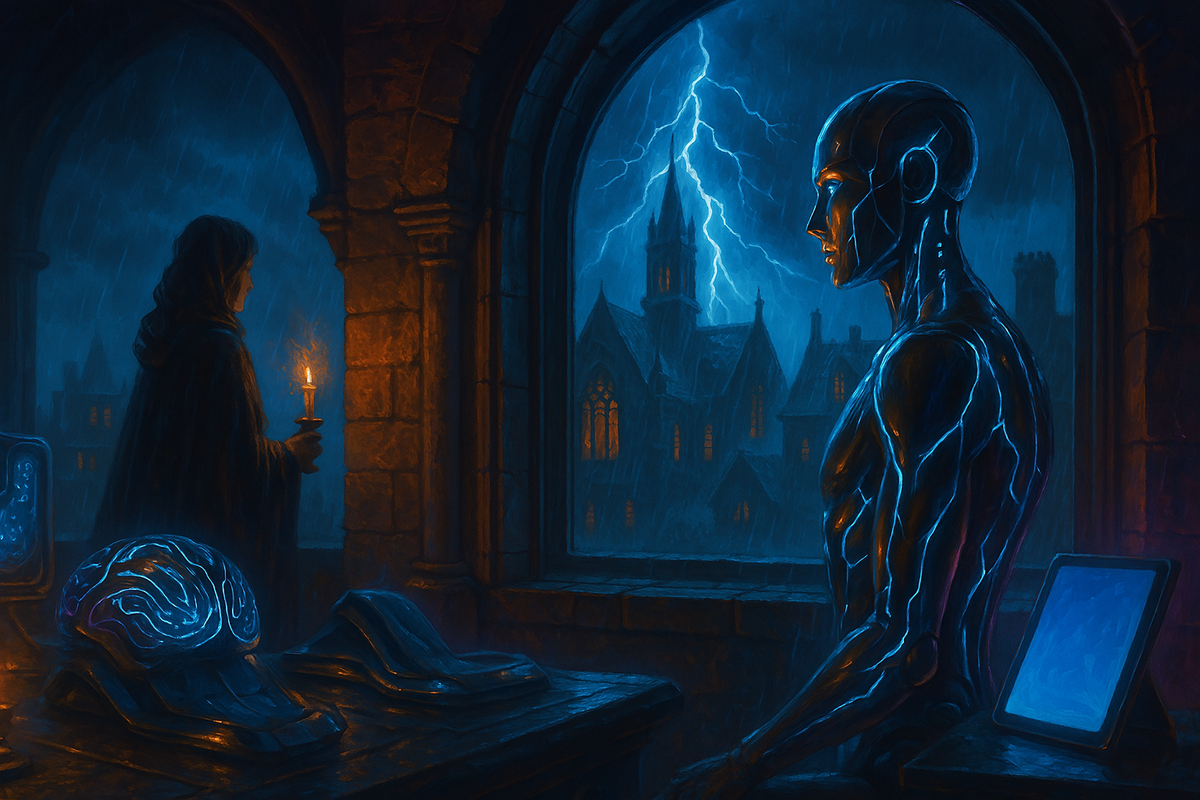
The Plot
Frankissstein: A Love Story by Jeanette Winterson is a novel that explores the intersection of artificial intelligence, gender identity, transhumanism, and the nature of humanity through two interwoven storylines.
The first storyline takes place in 1816 and follows Mary Shelley as she writes Frankenstein, inspired by the discussions and tensions within her literary circle, which includes Percy Bysshe Shelley, Lord Byron, and John Polidori. Winterson uses this historical frame to explore love, loss, creativity, and the conditions that gave rise to one of literature’s most enduring works.
The second storyline is set in the present day and follows Ry Shelley, a transgender doctor, who becomes involved in the world of artificial intelligence and body modification. Ry meets Victor Stein, a charismatic scientist and AI visionary, as well as Ron Lord, a businessman developing sex dolls and sexbots. Their overlapping interests in embodiment, technology, and artificial life drive the novel’s contemporary plot.
As the two storylines converge, the novel raises questions about the relationship between humans and machines, the meaning of consciousness, and the boundaries between life, death, and identity. It is a thought-provoking and inventive novel that reimagines Frankenstein for the age of AI.
Characters
The novel’s characters are layered and often defined by tension, contradiction, and transformation.
Ry Shelley is one of the central figures. He is a transgender doctor whose experience of embodiment gives the novel one of its most distinctive perspectives on identity. Ry is drawn into conversations about AI and technology, but the novel is equally interested in his interior life, his relationships, and the social pressures he faces as a trans man.
Victor Stein is the novel’s most explicit figure of techno-utopian ambition. He is fascinated by artificial intelligence, consciousness, and the possibility of transcending biological limits. His ideas are driven by both intellectual curiosity and a desire to overcome mortality, but Winterson also presents him as morally ambiguous and emotionally detached.
Ron Lord, by contrast, represents the commercial and sexual side of technological innovation. He is interested in building a profitable sex-doll empire, and his presence allows Winterson to satirize the commercialization of desire, intimacy, and futuristic fantasy.
Mary Shelley is also central to the novel. Winterson portrays her as a young writer working within a male-dominated literary world, while also showing how the emotional and intellectual dynamics of 1816 shape the creation of Frankenstein. Through Mary, the novel connects questions of authorship, creation, and responsibility across centuries.
AI in the novel
Winterson uses artificial intelligence as a way to ask larger philosophical questions about consciousness, embodiment, ethics, and what it means to be human.
The novel explores whether intelligence can be separated from the body, and whether consciousness can be simulated, transferred, or reproduced technologically. Rather than presenting AI as a simple triumph of progress, Winterson treats it as part of a broader set of anxieties about control, mortality, and human limitation.
The book also examines the ethical consequences of creation. In this sense, it echoes Mary Shelley’s Frankenstein: both works ask what happens when creators overreach, and whether the desire to build new forms of life or intelligence can ever be separated from responsibility.
The novel’s treatment of transhumanism is closely linked to this. It considers body modification, cryonics, and technological enhancement as ways of escaping ordinary human limits, but it never presents these possibilities as purely liberating. Instead, it asks what may be lost when the body becomes something to be redesigned, optimized, or overcome.
Ry’s trans identity is part of that inquiry, but the novel does not reduce him to a symbol. Rather, Winterson uses Ry’s experience to complicate fixed ideas about the body, identity, and selfhood, while also showing how trans existence is shaped by social prejudice and misunderstanding.
Conclusion
Frankissstein is a complex and ambitious novel that reworks the Frankenstein myth for a contemporary age of AI, biotechnology, and identity politics. Its strengths lie in its imaginative structure, its intellectual reach, and its ability to connect historical and futuristic forms of creation.
It may be challenging for some readers because of its dense ideas, shifting tones, and overtly essayistic passages. But for readers interested in the ethical and philosophical questions surrounding AI, embodiment, and human identity, it offers a rich and provocative reading experience.