
The Grey Service: Philippe Collin's The Barman of the Ritz
Every Sidecar mixed to Meier's specifications is a kind of unconscious memorial to the fact that beauty has no politics, or rather that it is indifferent to them, and this indifference has always been beauty's most troubling quality.

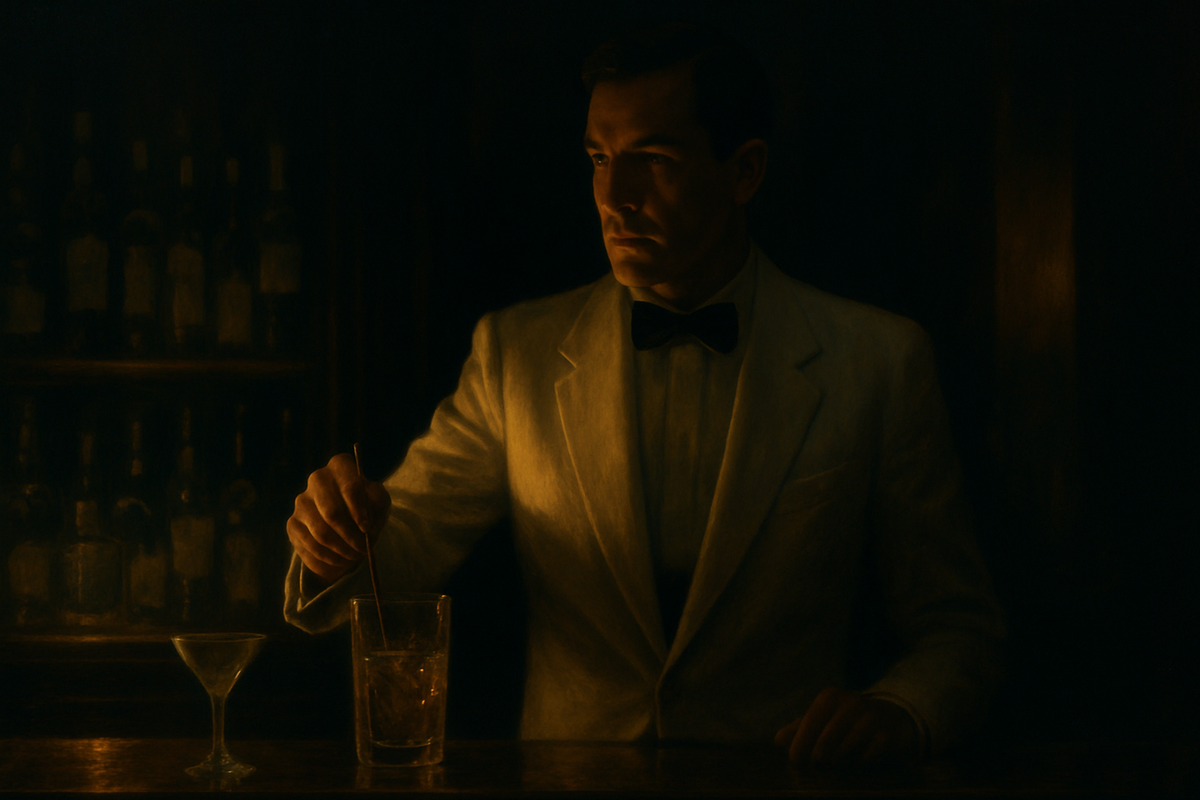
Picture the hands. They have been there all morning, arranging bottles, polishing glass, squeezing citrus over ice chipped by the same pick that has always occupied the same corner of the same bar. The year is 1941, or perhaps 1942 — the precision matters less than the constancy, because what defines these years inside the Ritz Paris is not their sequence but their sameness. The same field-grey uniforms ordering the same drinks, the same deference extended by a man who has learned to extend it without apparent cost. That man is Frank Meier: Austrian-born, head barman of the Ritz since 1921, present through the full duration of the German Occupation of Paris. He is also Jewish. Philippe Collin's The Barman of the Ritz — which began its life as a radio drama for France Inter before taking the form of the book it now is — places us inside this near-impossible conjunction: a Jewish craftsman serving cocktails to Hermann Göring's entourage, not because he had no choice, but because choice, in Meier's telling, is never the clean binary we require it to be in retrospect.
This is where the book begins, and where it refuses to end.
Collin's central gambit is audacious and morally uncomfortable in equal measure: he gives Meier a voice from beyond death. The narrative is a posthumous deposition, a first-person monologue delivered with the calm specificity of someone who has had long enough — decades, in the event — to arrange his account and is not entirely sure, even now, that he has arranged it honestly. This matters enormously. A lesser writer might have used the posthumous vantage to grant Meier either vindication or condemnation — the two responses that history most commonly reaches for. Collin refuses both. Meier speaks, and what accumulates is not a verdict but an atmosphere: the particular moral humidity of a life lived in proximity to horror without quite touching it, or so the speaker maintains.
The book's formal origins leave a mark on the prose, though not one that demands labouring. Collin is a radio man, and the sentences have been shaped by the knowledge that they would first be heard rather than read. They arrive cleanly, without the architectures of literary self-consciousness; no subordinate clauses are reaching for a grandeur the subject might otherwise invite. This restraint is either a brilliant formal correlation or the most natural consequence in the world — and possibly it is both — because Meier, after all, was a man whose entire professional identity had been built on suppression: the suppression of personality into service, of preference into the customer's preference, of self into role. That his narrating voice carries this same quality — meticulous, stripped of display, careful without being cautious — creates a resonance between form and content that sustains the book even when its events are at their most intractable. The voice does not tremble. It is this very steadiness that unsettles.
What persists across the distance of translation — French to Portuguese to the reader's interior — is the essential quality of testimony: direct address, the implied listener, a slight defensiveness beneath each apparently neutral statement. When Meier says, in effect, I made them good drinks, the space after is crowded with everything he does not say: and they drank them, and they were grateful to me, and this was a transaction we entered willingly on both sides, and I am still not sure what that means. Collin has written a book that is constituted as much by its silences as its speech. His Meier is not a man who has found peace with his choices; he is a man who has achieved, through long practice, a presentational calm that should not be mistaken for resolution.
The question of moral ambiguity under extremity is, of course, not new literary territory. From Primo Levi's grey zone to Hannah Arendt's patient dissection of those who administered rather than enacted the worst, we have spent the better part of a century trying to map the ethical terrain between resistance and collaboration — terrain that is, in practice, not so much a spectrum as a fog. What Collin adds to this body of thinking is the specificity of craft. Meier is not an administrator, not a bureaucrat managing paper at a safe remove from consequence. He is a craftsman in the fullest sense: a man for whom quality is not incidental to identity but inseparable from it. Every cocktail he mixes is an act of sustained attention — correct proportions, appropriate temperature, the right glass, the right moment of service. His excellence is precisely what the book is about. The question Collin is really asking is whether the pursuit of excellence, when exercised for the wrong audience, becomes a form of complicity more subtle and perhaps more durable than outright collaboration. The incompetent servant who serves the occupier at least gives them bad service. The brilliant one gives them something to return for.
This is where The Barman of the Ritz is most uncomfortable, and most honest. Meier, in Collin's reconstruction, does not merely tolerate the presence of the German high command in his bar — he arguably makes their occupation more aesthetically coherent, more humanly textured, more pleasant in a way that has real consequences for how comfortable the Ritz feels as a seat of power. He is, in some register, the best thing about their Paris. One thinks of the way certain European cultural institutions — orchestras, opera houses, national galleries — continued to function under occupation, providing a veneer of civilisation that the occupiers actively used to dignify themselves. The Ritz bar is a version of this, compressed into one man's two hands. And the question Collin will not answer for us — wisely, honestly — is whether those hands are heroic for their steadiness or compromised by it.
It is worth noting, in this context, that the book treats the Ritz itself with an ambivalence it does not always fully dramatise. The hotel is one of the great European monuments to organised luxury, a place where the beautiful life has been performed for over a century and where the gap between money and its display is deliberately maintained at its most aesthetically flattering. Collin is aware that this setting is not neutral — that the hotel's legendary quality is inseparable from its exclusions, its cultivated remove from ordinary consequence. But there are passages where the book seems, briefly, seduced by the very atmosphere it means to interrogate. The descriptions of ritual and craft and the bar's physical beauty carry a warmth that is probably faithful to Meier's own feeling for the place, but which occasionally sits uneasily alongside the political weight of what is being served within it. This is a minor complaint, and perhaps an inevitable one — research affection is hard to fully discipline. But it is the one place where the fog lifts to reveal a settled aesthetic preference where moral uncertainty might serve better.
I have been sitting with this book for several weeks now, turning its central question over in the way one turns a stone one cannot quite put down. I kept expecting to arrive at a settled position and kept finding, instead, that the question was migrating.
What finally named the feeling for me was not anything from history or philosophy but something from my own practice. I often photograph people in public spaces. I am drawn to these figures because something in the geometry of their situation — the asymmetry between the monumental and the human — feels as though it contains a truth worth fixing in place. But I have never been fully at peace with what I am doing. The question I cannot resolve, and that Collin's book returned to me with renewed force, is this: when I point a camera at someone enduring a condition of diminishment, am I bearing witness to their reality, or am I making that reality beautiful enough that the discomfort passes? Is the photograph an act of restoration or of aestheticisation — and is there, in the end, a meaningful difference?
Collin is doing something structurally similar to Meier. He is, seventy years after the fact, making this man's impossible situation available to us as a literary experience: elegiac, morally serious, formally precise. He has preserved Meier's hands in amber. The result is a book I admire and trust — one that refuses its own consolations — but the act of preservation is not itself innocent. Meier, in death, becomes a subject. His unresolved ambiguity becomes our aesthetic experience. This is not an accusation of Collin; it is the inescapable condition of literature that takes its materials from atrocity. The dead cannot represent themselves. Someone must speak in their name, and speaking in someone's name is always, in some degree, a decision about what that name means. The best writers of this kind of work carry that knowledge visibly. Collin, for the most part, does — but I would be dishonest if I did not say that the book's elegiac beauty occasionally gives me the same pause that I feel in my own darkroom.
The cultural resonance of the Ritz under Occupation points toward something that European self-understanding has never quite finished with: the way luxury and aesthetic cultivation have historically provided cover for, or coexisted with, political horror. This is not a comfortable observation for a continent that tends to think of its high culture as one of its cleaner inheritances. The Ritz in 1943 is an extreme instance of something that has gentler, more ordinary iterations — the excellent restaurant that doesn't ask where the money comes from, the beautiful building designed without curiosity about its patron's conduct, the prestigious institution that continues its work with professional dignity while the machinery around it turns in directions it prefers not to examine. Collin's book doesn't make these connections explicitly — it would be a lesser book if it did — but it charges the air in a way that makes such thinking almost unavoidable.
And there is a contemporary relevance here that Collin could not have anticipated when he was researching the interwar Ritz, but which has grown more pointed since. We live in a moment of renewed attention to complicity — to what it means to work within, contribute to, or benefit from systems whose full implications we prefer not to follow to their conclusion. The temptation to find in Meier either exculpation (he was just doing his job; he had no real power; what choice did he have?) or condemnation (he served murderers and made it pleasant) is precisely the temptation we face when we examine our own positions within institutions, industries, and economic arrangements whose effects extend well beyond our immediate intentions. The book does not allow either move. It insists on the irreducible difficulty of the position, and in doing so, insists on our own.
Frank Meier died in 1947, less than three years after the Liberation. He was not tried, not celebrated, not publicly examined. He left behind the Ritz's employment records and the recipes of cocktails that are still mixed today in bars that carry his name. That last detail is almost unbearable: the drinks persist while the moral reckoning remains permanently unfinished. Every Sidecar mixed to Meier's specifications is a kind of unconscious memorial to the fact that beauty has no politics, or rather that it is indifferent to them, and this indifference has always been beauty's most troubling quality. Collin's book plants itself inside that indifference and refuses to leave.
The Barman of the Ritz is the kind of work that shifts, not dramatically, the angle from which one sees certain things. After reading it, I found myself thinking differently about craftspeople who work within systems of power — the excellent teacher inside the inadequate institution, the careful archivist in the compromised ministry, the photographer who makes beautiful images of people whose beauty coexists with their diminishment. These are not equivalences. Occupation is not institutional inertia, and an educational institution is not the Paris Ritz in 1942. But the underlying question — what we owe our craft, what our craft owes history, whether excellence is ever morally neutral — is genuinely shared across these distances. Collin has written a small book with an extended gravitational field.
We will probably not agree on Frank Meier. His ghost would, I think, find that appropriate.